
Reference values for sit-to-stand tests in Colombian adults a multicenter cross-sectional study

Keywords:
adult, exercise test, reference values, physical functional performance, Body Mass Index, metabolic diseasesArticle Sidebar
Main Article Content
Background
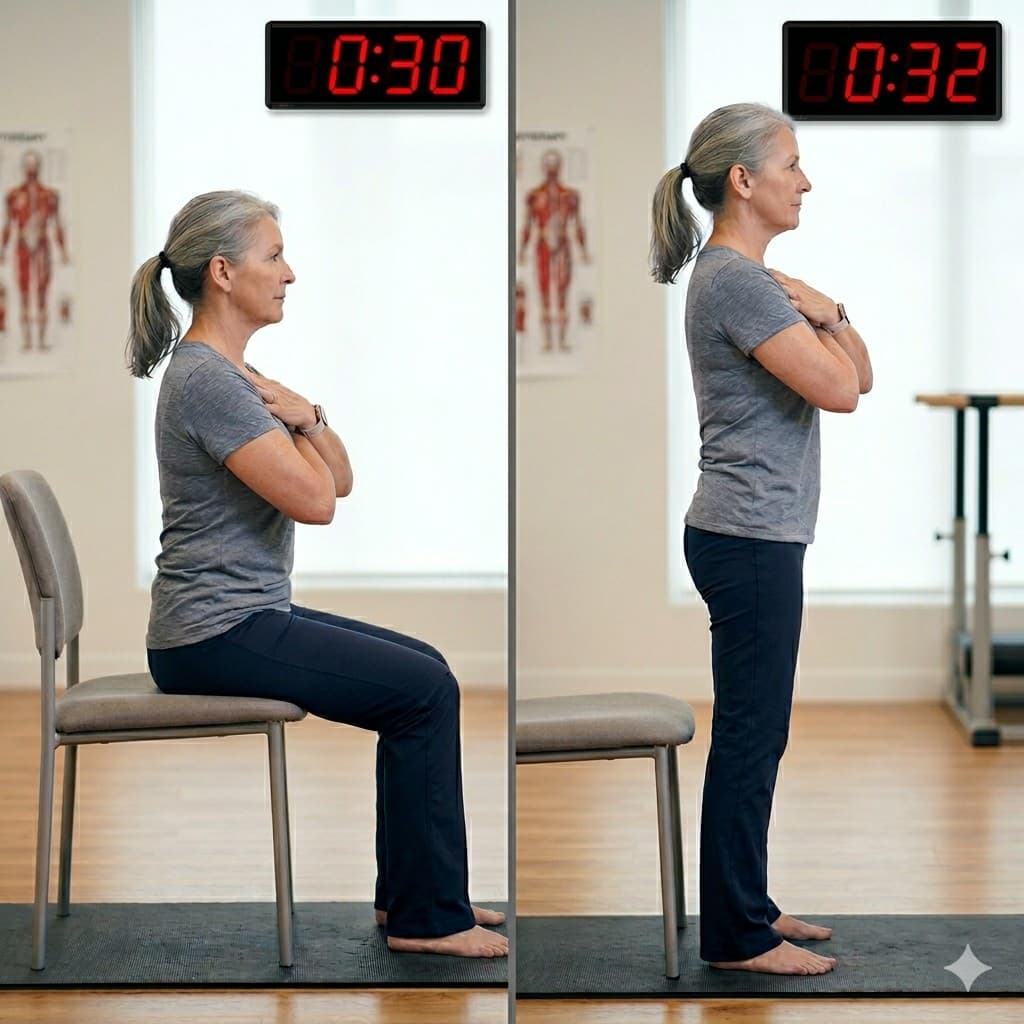
Submaximal tests such as the Sit-to-Stand Test (STS) in its three modalities are used to evaluate strength and aerobic capacity in people with respiratory, cardiovascular, and metabolic diseases. However, international reference values do not account for the genetic and environmental particularities of the Colombian population, underscoring the need to establish local references.
Aim
To establish sex and age-specific reference values for the 5-repetition, 30-second, and 1-minute sit-to-stand tests in community-dwelling Colombian adults.
Methods
A cross-sectional study was conducted between 2023 and 2024 in Colombia, with the participation of healthy adults aged 18 to 80 years. Anthropometric characteristics and physical activity were assessed using the IPAQ questionnaire and the Sit-to-Stand Test (STS) at 1 minute, 30 seconds, and 5 repetitions. Normative percentiles were calculated by sex and age with a sample of 393 people.
Results
The study included 393 participants (208 women and 185 men), with an average age of 44 years and a BMI of 25.9 ± 4.1. Age was negatively correlated with repetitions (R= 0.493; 60 sec and R= -0.497; 30 sec), height showed a positive correlation (R= 0.262; 60 sec). High BMI was associated with worse performance (R= -0.119; 60 sec, R= -0.153; 30 sec).
Conclusions
This study establishes reference values for STS testing in healthy adults in Colombia, accounting for age, sex, BMI, and physical activity.
Jenifer Rodríguez-Castro, Fundación Universitaria de Ciencias de la Salud
 https://orcid.org/0000-0001-6259-3671
Fundación Universitaria de Ciencias de la Salud, Facultad de Ciencias del Movimiento, Professor, Bogotá, Colombia.
Vicente Benavides-Cordoba, Universidad del Valle
https://orcid.org/0000-0002-9129-0183
Universidad del Valle, Facultad de Salud, Escuela de Ciencias Básicas, Departamento de Ciencias Fisiológicas, Professor, Cali, Colombia
Rodrigo Torres-Castro, Universidad de Chile
https://orcid.org/0000-0001-7974-4333
Universidad de Chile, Departamento de Kinesiología, Professor, Independencia, Región Metropolitana, Chile.
Matías Otto-Yáñez, Universidad Autónoma de Chile
https://orcid.org/0000-0001-5784-275X
Universidad Autónoma de Chile, Facultad de Ciencias de la Salud, Kinesiología, Grupo de investigación en Salud, Funcionalidad y Actividad Física (GISFAF), Professor, Providencia, Santiago de Chile, Chile.
Jhonatan Betancourt-Peña, Institución Universitaria Escuela Nacional del Deporte
https://orcid.org/0000-0002-7292-7628
Institución Universitaria Escuela Nacional del Deporte, Facultad de Salud y Rehabilitación, Proffesor, Cali, Colombia.
Juan Carlos Ávila-Valencia, Institución Universitaria Escuela Nacional del Deporte
https://orcid.org/0000-0003-3642-6428
Institución Universitaria Escuela Nacional del Deporte, Facultad de Salud y Rehabilitación, Proffesor, Cali, Colombia.
1. Arena R, Myers J, Williams MA, Gulati M, Kligfield P, Balady GJ, et al. Assessment of functional capacity in clinical and research settings: a scientific statement from the american heart association committee on exercise, rehabilitation, and prevention of the council on clinical cardiology and the council on cardiovascular nursing. Circulation. 2007;116(3):329-43. https://doi.org/10.1161/CIRCULATIONAHA.106.184461. PMid:17576872 DOI: https://doi.org/10.1161/CIRCULATIONAHA.106.184461
2. Ammar H, Hashish R, Mohamed AS, Salem A, Hagras A. Evaluation of functional aerobic exercise capacity among chronic e-cigarette users compared to combustible cigarette smokers and non-smokers: a comparative study. Bull Fac Phys Ther. 2023;28(1):43. https://doi.org/10.1186/s43161-023-00154-7 DOI: https://doi.org/10.1186/s43161-023-00154-7
3. Medrano-Ureña MDR, Ortega-Ruiz R, Benítez-Sillero JD. Physical fitness, exercise self-efficacy, and quality of life in adulthood: a systematic review. Int J Environ Res Public Health. 2020;17(17):6343. https://doi.org/10.3390/ijerph17176343. PMid:32878182; PMCid:PMC7504332 DOI: https://doi.org/10.3390/ijerph17176343
4. Cruz-Montecinos C, Torres-Castro R, Otto-Yáñez M, Barros-Poblete M, Valencia C, Campos A, et al. Which sit-to-stand test best differentiates functional capacity in older people? Am J Phys Med Rehabil. 2024;103(10):925-8. https://doi.org/10.1097/PHM.0000000000002504. PMid:38630944 DOI: https://doi.org/10.1097/PHM.0000000000002504
5. Fuentes-Abolafio IJ, Escriche-Escuder A, Bernal-López MR, Gómez-Huelgas R, Ricci M, Trinidad-Fernández M, et al. Estimation of functional aerobic capacity using the sit-to-stand test in older adults with heart failure with preserved ejection fraction. J Clin Med. 2022;11(10):2692. https://doi.org/10.3390/jcm11102692. PMid:35628819; PMCid:PMC9146258 DOI: https://doi.org/10.3390/jcm11102692
6. Léger LA, Mercier D, Gadoury C, Lambert J. The multistage 20 metre shuttle run test for aerobic fitness. J Sports Sci. 1988; 6(2): 93-101. https://doi.org/10.1080/02640418808729800. PMid:3184250 DOI: https://doi.org/10.1080/02640418808729800
7. Léger L, Boucher R. An indirect continuous running multistage field test: the Université de Montréal track test. Can J Appl Sport Sci. 1980;5(2):77-84. PMID: 7389053.
8. Csuka M, McCarty DJ. Simple method for measurement of lower extremity muscle strength. Am J Med. 1985; 78(1): 77-81. https://doi.org/10.1016/0002-9343(85)90465-6. PMid:3966492 DOI: https://doi.org/10.1016/0002-9343(85)90465-6
9. Bohannon RW, Crouch R. 1-minute Sit-to-Stand Test: Systematic review of procedures, performance, and clinimetric properties. J Cardiopulm Rehabil Prev. 2019;39(1):2-8. https://doi.org/10.1097/HCR.0000000000000336. PMid:30489442 DOI: https://doi.org/10.1097/HCR.0000000000000336
10. Figueiredo PHS, Veloso LRDS, Lima MMO, Vieira CFD, Alves FL, Lacerda ACR, et al. The reliability and validity of the 30-seconds sit-to-stand test and its capacity for assessment of the functional status of hemodialysis patients. J Bodyw Mov Ther. 2021;27:157-164. https://doi.org/10.1016/j.jbmt.2021.02.020. PMid:34391227 DOI: https://doi.org/10.1016/j.jbmt.2021.02.020
11. Bohannon RW. Test-retest reliability of the five-repetition sit-to-stand test: a systematic review of the literature involving adults. J Strength Cond Res. 2011;25(11):3205-7. https://doi.org/10.1519/JSC.0b013e318234e59f. PMid:21904240 DOI: https://doi.org/10.1519/JSC.0b013e318234e59f
12. Spence JG, Brincks J, Løkke A, Neustrup L, Østergaard EB. One-minute sit-to-stand test as a quick functional test for people with COPD in general practice. NPJ Prim Care Respir Med. 2023;33(1):11. https://doi.org/10.1038/s41533-023-00335-w. PMid:36922535; PMCid:PMC10015133 DOI: https://doi.org/10.1038/s41533-023-00335-w
13. Zamboti CL, Pimpão HA, Bertin LD, Krinski GG, Garcia T, Dos Santos FSLS, et al. Functional measures in Non-COPD chronic respiratory diseases: a systematic review. J Clin Med. 2024;13(22):6887. https://doi.org/10.3390/jcm13226887. PMid:39598031 PMCid:PMC11595047 DOI: https://doi.org/10.3390/jcm13226887
14. Zampogna E, Pignatti P, Ambrosino N, Cherubino F, Fadda AM, Zappa M, et al. The 5-repetition sit-to-stand test as an outcome measure for pulmonary rehabilitation in subjects with asthma. Respir Care. 2021;66(5):769-76. https://doi.org/10.4187/respcare.08452. PMid:33593936 DOI: https://doi.org/10.4187/respcare.08452
15. Adsett JA, Bowe R, Kelly R, Louis M, Morris N, Hwang R. A Study of the Reliability, Validity, and Physiological Changes of Sit-to-Stand Tests in People With Heart Failure. J Cardiopulm Rehabil Prev. 2023; 43(3): 214-9. https://doi.org/10.1097/HCR.0000000000000739. PMid:36729608 DOI: https://doi.org/10.1097/HCR.0000000000000739
16. Keen C, Smith I, Hashmi-Greenwood M, Sage K, Kiely DG. Pulmonary Hypertension and Measurement of Exercise Capacity Remotely: Evaluation of the 1-min Sit-to-Stand Test (PERSPIRE) - a cohort study. ERJ Open Res. 2023;9(1):00295-2022. https://doi.org/10.1183/23120541.00295-2022. PMid:36699650; PMCid:PMC9868966 DOI: https://doi.org/10.1183/23120541.00295-2022
17. van Cappellen-van Maldegem SJM, Hoedjes M, Seidell JC, van de Poll-Franse LV, Buffart LM, Mols F, et al. Self-performed Five Times Sit-To-Stand test at home as (pre-)screening tool for frailty in cancer survivors: Reliability and agreement assessment. J Clin Nurs. 2023;32(7-8):1370-1380. https://doi.org/10.1111/jocn.16299. PMid:35332600 DOI: https://doi.org/10.1111/jocn.16299
18. Yamako G, Punchihewa NG, Arakawa H, Tajima T, Chosa E. Evaluation of Sit-to-Stand movement in older adults with locomotive syndrome using the Nintendo Wii balance board. Sensors (Basel). 2023;23(7):3368. https://doi.org/10.3390/s23073368. PMid:37050428; PMCid:PMC10098528 DOI: https://doi.org/10.3390/s23073368
19. Ozarda Y. Reference intervals: current status, recent developments and future considerations. Biochem Med (Zagreb). 2016;26(1):5-16. https://doi.org/10.11613/BM.2016.001. PMid:26981015; PMCid:PMC4783089 DOI: https://doi.org/10.11613/BM.2016.001
20. Strassmann A, Steurer-Stey C, Lana KD, Zoller M, Turk AJ, Suter P, et al. Population-based reference values for the 1-min sit-to-stand test. Int J Public Health. 2013;58(6):949-53. doi: 10.1007/s00038-013-0504-z. https://doi.org/10.1007/s00038-013-0504-z. PMid:23974352; PMCid:PMC7880481 DOI: https://doi.org/10.1007/s00038-013-0504-z
21. Furlanetto KC, Correia NS, Mesquita R, Morita AA, Do Amaral DP, Mont’Alverne DGB, et al. Reference values for 7 different protocols of simple functional tests: a multicenter study. Arch Phys Med Rehabil. 2022;103(1):20-28.e5. https://doi.org/10.1016/j.apmr.2021.08.009. PMid:34516997 DOI: https://doi.org/10.1016/j.apmr.2021.08.009
22. Lein DH, Alotaibi M, Almutairi M, Singh H. Normative reference values and validity for the 30-second chair-stand test in healthy young adults. Int J Sports Phys Ther. 2022; 17(5): 907-14. https://doi.org/10.26603/001c.36432. PMid:35949374; PMCid:PMC9340829 DOI: https://doi.org/10.26603/001c.36432
23. Klukowska AM, Staartjes VE, Vandertop WP, Schröder ML. Five-repetition sit-to-stand test performance in healthy individuals: reference values and predictors from 2 prospective cohorts. Neurospine. 2021; 18(4): 760-9. https://doi.org/10.14245/ns.2142750.375. PMid:35000330; PMCid:PMC8752709 DOI: https://doi.org/10.14245/ns.2142750.375
24. Otto-Yáñez M, Torres-Castro R, Barros-Poblete M, Barros M, Valencia C, Campos A, et al. One-minute sit-to-stand test: Reference values for the Chilean population. PLoS ONE. 2025;20(1):e0317594. https://doi.org/10.1371/journal.pone.0317594. PMid:39879255; PMCid:PMC11778653 DOI: https://doi.org/10.1371/journal.pone.0317594
25. Cuschieri S. The STROBE guidelines. Saudi J Anaesth. 2019;13(Suppl 1):S31-S34. https://doi.org/10.4103/sja.SJA_543_18. PMid:30930717; PMCid:PMC6398292 DOI: https://doi.org/10.4103/sja.SJA_543_18
26. Lee PH, Macfarlane DJ, Lam TH, Stewart SM. Validity of the International Physical Activity Questionnaire Short Form (IPAQ-SF): a systematic review. Int J Behav Nutr Phys Act. 2011; 8: 115. https://doi.org/10.1186/1479-5868-8-115. PMid:22018588; PMCid:PMC3214824 DOI: https://doi.org/10.1186/1479-5868-8-115
27. Johnson MJ, Close L, Gillon SC, Molassiotis A, Lee PH, Farquhar MC, et al. Use of the modified Borg scale and numerical rating scale to measure chronic breathlessness: a pooled data analysis. Eur Respir J. 2016; 47(6): 1861-4. https://doi.org/10.1183/13993003.02089-2015. PMid:26989107 DOI: https://doi.org/10.1183/13993003.02089-2015
28. DANE - Censo Nacional de Población y Vivienda 2018. [cited 28 january 2025]. Available: https://www.dane.gov.co/index.php/estadisticas-por-tema/demografia-y-poblacion/censo-nacional-de-poblacion-y-vivenda-2018
29. Wiedmer P, Jung T, Castro JP, Pomatto LCD, Sun PY, Davies KJA, et al. Sarcopenia - Molecular mechanisms and open questions. Ageing Res Rev. 2021; 65: 101200. https://doi.org/10.1016/j.arr.2020.1012003. PMid:33130247 DOI: https://doi.org/10.1016/j.arr.2020.101200
30. Narici MV, Maffulli N. Sarcopenia: characteristics, mechanisms and functional significance. Br Med Bull. 2010;95:139-59. https://doi.org/10.1093/bmb/ldq008. PMid:20200012 DOI: https://doi.org/10.1093/bmb/ldq008
31. Huang SW, Lee YH, Liao CD, Escorpizo R, Liou TH, Lin HW. Association of physical functional activity impairment with severity of sarcopenic obesity: findings from National Health and Nutrition Examination Survey. Sci Rep. 2024; 14(1): 3787. https://doi.org/10.1038/s41598-024-54102-z. PMid:38360804; PMCid:PMC10869697 DOI: https://doi.org/10.1038/s41598-024-54102-z
32. Li H, Konja D, Wang L, Wang Y. Sex differences in adiposity and cardiovascular diseases. Int J Mol Sci. 2022; 23(16): 9338. https://doi.org/10.3390/ijms23169338. PMid:36012601; PMCid:PMC9409326 DOI: https://doi.org/10.3390/ijms23169338
33. Baltasar-Fernandez I, Alcazar J, Mañas A, Alegre LM, Alfaro-Acha A, Rodriguez-Mañas L, et al. Relative sit-to-stand power cut-off points and their association with negatives outcomes in older adults. Sci Rep. 2021; 11(1): 19460. https://doi.org/10.1038/s41598-021-98871-3. PMid:34593917; PMCid:PMC8484545 DOI: https://doi.org/10.1038/s41598-021-98871-3
34. Ramírez-Vélez R, Izquierdo M, García-Hermoso A, Ordoñez-Mora LT, Cano-Gutierrez C, Campo-Lucumí F, et al. Sit to stand muscle power reference values and their association with adverse events in Colombian older adults. Sci Rep. 2022; 12(1): 11820. https://doi.org/10.1038/s41598-022-15757-8. PMid:35821249; PMCid:PMC9276682 DOI: https://doi.org/10.1038/s41598-022-15757-8
35. Kim M, Won CW. Cut points of chair stand test for poor physical function and its association with adverse health outcomes in community-dwelling older adults: a cross-sectional and longitudinal study. J Am Med Dir Assoc. 2022; 23(8): 1375-1382.e3. https://doi.org/10.1016/j.jamda.2021.11.007. PMid:34883057 DOI: https://doi.org/10.1016/j.jamda.2021.11.007
36. Khalili G, Zargoush M, Huang K, Ghazalbash S. Exploring trajectories of functional decline and recovery among older adults: a data-driven approach. Sci Rep. 2024; 14(1): 6340. https://doi.org/10.1038/s41598-024-56606-0. PMid:38491130; PMCid:PMC10943109 DOI: https://doi.org/10.1038/s41598-024-56606-0
37. Mittaz HA-G, Mathieu N, Lenoble-Hoskovec C, Swanenburg J, de Bie R, Hilfiker R. Effects of three home-based exercise programmes regarding falls, quality of life and exercise-adherence in older adults at risk of falling: protocol for a randomized controlled trial. BMC Geriatr. 2019; 19(1): 13. https://doi.org/10.1186/s12877-018-1021-y. PMid:30642252; PMCid:PMC6332592 DOI: https://doi.org/10.1186/s12877-018-1021-y
38. Sampa MB, Hoque MR, Hossain MN. Impacts of anthropometric, biochemical, socio-demographic, and dietary habits factors on the health status of urban corporate people in a developing country. Healthcare (Basel). 2020;8(3):188. https://doi.org/10.3390/healthcare8030188. PMid:32605101; PMCid:PMC7551820 DOI: https://doi.org/10.3390/healthcare8030188
39. Reis RS, Salvo D, Ogilvie D, Lambert EV, Goenka S, Brownson RC, et al. Scaling up physical activity interventions worldwide: stepping up to larger and smarter approaches to get people moving. Lancet. 2016; 388(10051): 1337-48. https://doi.org/10.1016/S0140-6736(16)30728-0. PMid:27475273; PMCid:PMC5193005 DOI: https://doi.org/10.1016/S0140-6736(16)30728-0
Downloads

This work is licensed under a Creative Commons Attribution-NonCommercial 4.0 International License.
The copy rights of the articles published in Colombia Médica belong to the Universidad del Valle. The contents of the articles that appear in the Journal are exclusively the responsibility of the authors and do not necessarily reflect the opinions of the Editorial Committee of the Journal. It is allowed to reproduce the material published in Colombia Médica without prior authorization for non-commercial use